When we contemplate jobs worse than ours, one that doesn't often come up but has to be bad is call screener for a radio or (less common these days) television show. Howard Stern alone probably nearly killed this career. I had jobs in my youth that involved answering the phones at businesses and it's stressful being the gatekeeper for every shut-in, teenager and pervert (or some unholy combination of the above) with a telephone, even when you aren't on the public airwaves. If you don't believe me, try working third shift at a hotel.
Despite my sympathy for folks so employed, the screeners on Science Friday seem either particularly gullible or the show is just target for a lot of wackos who can't locate "Coast to Coast" on their dials. You can guarantee some religious wack job will call in almost every time they open the phone lines, as will someone who questions "What good does this do?" to anyone who isn't literally curing cancer or whatever they feel is morally acceptable for all scientific types should be working on.
Lawrence Krauss was on recently plugging his new book, A Universe From Nothing, and was discussing among other things dark energy (to review: the universe is growing colder and farther apart infinity or as the late Christopher Hitchens put it, hurrying towards nothing.) One deep thinker called in to say, "I think dark energy should be called 'God's glue.' " That's great, man. I think traffic roundabouts should be called "monkey circle droppings" and that 2 Broke Girls should be called "lame vagina joke cesspool." Also, I don't like grapes with brown spots on them. Thanks for letting me share these equally relevant observations.
At any rate, Krauss had a brilliant response that I wish I could recreate verbatim which essentially boiled down to isn't that the great thing about science is that, unlike religion, scientists don't mind and in fact enjoy having their beliefs challenged. That they don't require their world to be unshakable no matter what things are called.
And the "What's the point, blah blah cancer" guy called in too, of course. WTF is happening, Science Friday? Do you want those calls? Are not enough real questions coming in? Is this like some pledge drive torture device?
Anyways, I think I'll add Krauss's book to my queue. And probably never read it but it'll make me look smart. Or, smarter.
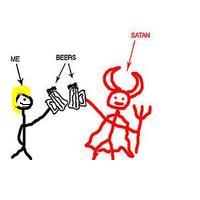
In which I engage in shallow discussions about books, movies, science, history and whatever else I'm thinking at that moment. And have beers with Captain Howdy.
Showing posts with label random science. Show all posts
Showing posts with label random science. Show all posts
Tuesday, January 24, 2012

Tuesday, July 12, 2011
Things I'm wondering about this week
I called my mother the other day and caught her in the middle of watching Starship Troopers. I could just as easily say I'm wondering why my mother would be watching something like Starship Troopers. But let's not get existential. I mentioned to her that some people complained that the Heinlein source material was antisemitic, or at least that is what I remembered. We both agreed that clearly there is nothing about the movie that struck us that way unless Denise Richards is Jewish which would be an embarrassment to Jews everywhere.
I googled this and couldn't find a lot. One was a comment on a far-right wackjob site that I'm not going to link to (apparently, liberals want you to believe that it's racist. He's totally right too. It's all part of my brilliant liberal conspiracy to take over the country and kill Jesus by convincing dittoheads that Paul Verhoeven films suck. Bwah ha ha. Except for Showgirls which is totally awesome. I'm erect, why aren't you erect?)
The evidence in the Wikipedia article is pretty flimsy. They just say basically that "bugs" sounds an awful lot like "Jews" (really? How are you pronouncing that?) And Verhoeven's uniforms looked kinda Nazi-ish but Verhoeven says he didn't even finish the book-it was boring and depressing. Hah! I love you Paul Verhoeven. All is forgiven.
I read Stranger in a Strange Land and HATED it violently so I will not be reading anymore Heinlein but it's interesting how jingoistic Starship supposedly is while Stranger is so hippy dippy-and sexist. I've heard The Moon is a Harsh Mistress is interesting but a really tedious read. Everyone speaks in some kind of patois that is difficult to pick up on. No thanks.
So, I dunno on all that. Onto other matters. Namely, my co-worker Herb came into my office today and was admiring my periodic table. He mentioned that thorium is being looked at as a reactor fuel that is better and more stable than uranium. We wondered why, if that's so, it hadn't been considered before.
I wondered if it was rare but that's not the case. Apparently, it's been known for a while that thorium is a good alternative and will produce less waste. The reason it's not being used is mainly to do with the existing infrastructure, which is set up to use uranium. The decision to use uranium was originally driven by Cold War expediencies. India and Australia have huge thorium reserves.
I googled this and couldn't find a lot. One was a comment on a far-right wackjob site that I'm not going to link to (apparently, liberals want you to believe that it's racist. He's totally right too. It's all part of my brilliant liberal conspiracy to take over the country and kill Jesus by convincing dittoheads that Paul Verhoeven films suck. Bwah ha ha. Except for Showgirls which is totally awesome. I'm erect, why aren't you erect?)
The evidence in the Wikipedia article is pretty flimsy. They just say basically that "bugs" sounds an awful lot like "Jews" (really? How are you pronouncing that?) And Verhoeven's uniforms looked kinda Nazi-ish but Verhoeven says he didn't even finish the book-it was boring and depressing. Hah! I love you Paul Verhoeven. All is forgiven.
I read Stranger in a Strange Land and HATED it violently so I will not be reading anymore Heinlein but it's interesting how jingoistic Starship supposedly is while Stranger is so hippy dippy-and sexist. I've heard The Moon is a Harsh Mistress is interesting but a really tedious read. Everyone speaks in some kind of patois that is difficult to pick up on. No thanks.
So, I dunno on all that. Onto other matters. Namely, my co-worker Herb came into my office today and was admiring my periodic table. He mentioned that thorium is being looked at as a reactor fuel that is better and more stable than uranium. We wondered why, if that's so, it hadn't been considered before.
I wondered if it was rare but that's not the case. Apparently, it's been known for a while that thorium is a good alternative and will produce less waste. The reason it's not being used is mainly to do with the existing infrastructure, which is set up to use uranium. The decision to use uranium was originally driven by Cold War expediencies. India and Australia have huge thorium reserves.
Friday, June 24, 2011
What I looked up thus far for The Coroner's Lunch
The book takes place in October of 1976. This means the Pathet Lao takeover is about a year in. Although considered the equivalent of the Viet Minh or Khmer Rouge, they never seemed to be as bad or, at least, they never made the news if they were. They certainly were bad news for the Hmong, who had collaborated with us. The numbers aren't clear but thousands fled the country following Communist takeover by crossing the Mekong into Thailand-the town on the Thai side by the way is Sri Chaing Mai which is evidently the spring roll capital. There are refugees scattered all over-in the States, in Australia, in Thailand (where they've been having troubles recently.) There have been efforts to both improve US-Laos relations and repatriate the Hmong but the results are mixed. According to Wikipedia, the Hmong were called Montagnards by the French because they lived in highland areas but they shouldn't be confused the the Vietnamese Degar, who were also called Montagnards.
Pathet Lao just means "Lao Country."
The Laotian Civil War lasted from 1953-1975. This means it pretty much had been going on ever since the French officially withdrew after the Battle of Dien Bien Phu. The battle was actually very close to the Laos border:

After 1953, the history gets too complicated to summarize well but there's more here. There were various coups and corruption caused by an influx of US aid. We of course were freaked out by the creeping Communist umbrella. According to the article. Laos is the most bombed nation in the history of war.
The article says the LPRP (Lao People's Revolutionary Party) is still in control but they have been enacting economic reforms since 1986. They are a poor country with lots of debt. The Lonely Planet once again assures me this is an great, cheap and low crime place to travel.
Comrade Kahm tells Siri that he knows the cause of his wife's sudden death: her addiction to lahp, a raw meat dish. Apparently, it can also be served cooked. Which is good news for Laotians. Lahp seems to just mean "minced." You can even have tofu lahp. Here's the recipe.
She actually died from cyanide poisoning, the almond smell being the standard dead giveaway. I'd read various mystery novels for years where someone sniffed the cadaver's breath for an almond smell but it was only recently that I learned why that smell was connected to cyanide.
The almonds we eat are Prunus dulcis, the ones that produce cyanide in significant quantities are Prunus amara. Turning the original poisonous version into the key ingredient for Almond Joy is the result of a simple human-induced genetic mutation. Plants produce cyanide as a defense mechanism. Some other common foods that contain cyanide (reduced to safe amounts such as selective breeding) are lima beans, soy, spinach and cassava. There are people in Africa whose diets, principally due to war and famine, consist mainly of cassava who suffer from a low-grade form of cyanide poisoning called konzo.
In passing, Siri mentions the Anusawari Arch. I wanted to go into a little more detail because it's quite striking and because the back story is funny.
First here it is:

It looks old but it was built between 1957-1968 and is a monument to those who died in the battle for independence from France. It's also known as Patuxai or "Victory Gate." Evidently, it was built with American money and cement that was intended for an airstrip. Oops. Well, at least it's pretty. It is sometimes known as "the vertical runway" for that reason.
It's mentioned a few times about people being sent to Vieng Xai (or Viengsai) for re-education. This was the stronghold of the Pathet Lao during the insurgency and where the took shelter in the cave system during the US bombing. It's supposed to be a very lovely place. Here and here is some more information about traveling there.
Pathet Lao just means "Lao Country."
The Laotian Civil War lasted from 1953-1975. This means it pretty much had been going on ever since the French officially withdrew after the Battle of Dien Bien Phu. The battle was actually very close to the Laos border:

After 1953, the history gets too complicated to summarize well but there's more here. There were various coups and corruption caused by an influx of US aid. We of course were freaked out by the creeping Communist umbrella. According to the article. Laos is the most bombed nation in the history of war.
The article says the LPRP (Lao People's Revolutionary Party) is still in control but they have been enacting economic reforms since 1986. They are a poor country with lots of debt. The Lonely Planet once again assures me this is an great, cheap and low crime place to travel.
Comrade Kahm tells Siri that he knows the cause of his wife's sudden death: her addiction to lahp, a raw meat dish. Apparently, it can also be served cooked. Which is good news for Laotians. Lahp seems to just mean "minced." You can even have tofu lahp. Here's the recipe.
She actually died from cyanide poisoning, the almond smell being the standard dead giveaway. I'd read various mystery novels for years where someone sniffed the cadaver's breath for an almond smell but it was only recently that I learned why that smell was connected to cyanide.
The almonds we eat are Prunus dulcis, the ones that produce cyanide in significant quantities are Prunus amara. Turning the original poisonous version into the key ingredient for Almond Joy is the result of a simple human-induced genetic mutation. Plants produce cyanide as a defense mechanism. Some other common foods that contain cyanide (reduced to safe amounts such as selective breeding) are lima beans, soy, spinach and cassava. There are people in Africa whose diets, principally due to war and famine, consist mainly of cassava who suffer from a low-grade form of cyanide poisoning called konzo.
In passing, Siri mentions the Anusawari Arch. I wanted to go into a little more detail because it's quite striking and because the back story is funny.
First here it is:

It looks old but it was built between 1957-1968 and is a monument to those who died in the battle for independence from France. It's also known as Patuxai or "Victory Gate." Evidently, it was built with American money and cement that was intended for an airstrip. Oops. Well, at least it's pretty. It is sometimes known as "the vertical runway" for that reason.
It's mentioned a few times about people being sent to Vieng Xai (or Viengsai) for re-education. This was the stronghold of the Pathet Lao during the insurgency and where the took shelter in the cave system during the US bombing. It's supposed to be a very lovely place. Here and here is some more information about traveling there.
Thursday, April 7, 2011
More from Bangkok 8 and carbon dating the Voynich Manuscript
Bangkok 8 mentions the Hilton having a spirit house surrounded by phalluses because it it for males. Or something like that. I can't find any images of a spirit house garden for the Bangkok Hilton (the real one, not the prison) but Thai spirit houses are everywhere on the nets. And quite pretty.
This website has a selection of the various types. They are built to appease spirits and nearly every Thai home and business has them displayed in some prominent spot. They are typically birdhouse-sized although some seem to be doll house sized. The pointed structures at the corners of the roof are intended to deflect evil spirits why they fall (why wouldn't they detract good spirits too? It's a mystery.) Here's some more about Thai spirit houses here. Interestingly, supposedly they are rarely occupied by birds despite their convenient size. They are also used in Burma, Cambodia and Laos.
I listened to this week's Skeptoid podcast this week about the Voynich Manuscript. I'd never heard of it but it's a famous medieval manuscript written in an as yet undecipherable language (it does appear to cryptologists to look like a language instead of gibberish.) What I thought was interesting was not the secret mojo that it no doubt contains if only we could just crack the code (I'll leave that to Dan Brown) but the discussion on carbon dating. They are able to date the paper but not the ink because ink isn't necessarily of organic origin. I had never thought about that before but it makes sense. They do not as yet have a reliable way to date the ink in any case and still rule out contamination from the paper materials. They can make a reasonable guess as to the age of the document however based on the paper as there is no trace residue of anything that would have cleaned previous writings off of the parchment. As paper used to be a high-priced item, this was a common practice.
It's quite pretty and has some...odd drawings in it. Here is a site with more information and images. Yale Library is its current custodian.
This website has a selection of the various types. They are built to appease spirits and nearly every Thai home and business has them displayed in some prominent spot. They are typically birdhouse-sized although some seem to be doll house sized. The pointed structures at the corners of the roof are intended to deflect evil spirits why they fall (why wouldn't they detract good spirits too? It's a mystery.) Here's some more about Thai spirit houses here. Interestingly, supposedly they are rarely occupied by birds despite their convenient size. They are also used in Burma, Cambodia and Laos.
I listened to this week's Skeptoid podcast this week about the Voynich Manuscript. I'd never heard of it but it's a famous medieval manuscript written in an as yet undecipherable language (it does appear to cryptologists to look like a language instead of gibberish.) What I thought was interesting was not the secret mojo that it no doubt contains if only we could just crack the code (I'll leave that to Dan Brown) but the discussion on carbon dating. They are able to date the paper but not the ink because ink isn't necessarily of organic origin. I had never thought about that before but it makes sense. They do not as yet have a reliable way to date the ink in any case and still rule out contamination from the paper materials. They can make a reasonable guess as to the age of the document however based on the paper as there is no trace residue of anything that would have cleaned previous writings off of the parchment. As paper used to be a high-priced item, this was a common practice.
It's quite pretty and has some...odd drawings in it. Here is a site with more information and images. Yale Library is its current custodian.
Thursday, March 24, 2011
A pre-Cambrian fossil story and what Daft Punk, Doctor Who, Droogs and Churchill have in common
PRI's The World in Words had a story about the vocoder. Doctor Who fans will know it as the voice of the Daleks. Daft Punk fans will know it from half of their albums. Clockwork Orange fans will know it from the horrorshow version of Ludwig Van's "Ode to Joy" in the score. But after its invention at Bell Labs in 1936, it took a detour through the war effort. It was used to encode some phone conversations between Churchill and FDR. Apparently, Eisenhower did not like sounding like a chipmunk but I'd love to know what he'd sound like singing "One More Time."
The Beeb has a series where David Attenborough reflects on random things: the evolution of the kiwi bird, climbing a rope in South America and the spice trade. One of the episodes was about the Charnia fossil. As a boy, he was an avid fossil hunter but he never hunted in the Charnwood Forest near his home in central England (near Birmingham) because he knew the rocks were too old, that is Precambrian. A schoolboy found the first specimen there in 1957 which changed our understanding of that era. The fossil, first thought to be algae, appear to be some kind of soft coral. The fossil is at first glance not that exciting but it has huge repercussions. Until then, some thought the Precambrian was devoid of life. Since then, more varieties of Chania have been found. Apparently, Newfoundland is one of the best places to look for them. Of course, it's difficult to make sweeping statements when the Precambrian was so freaking long-that is, 4000 to 543 Million years ago freaking long. These fossils are now considered to come from the Ediacaran period, which directly preceeded the Cambrian. Here is a picture of the original Charnia on display at the Leicester New Walk Museum.
Wednesday, February 16, 2011
More I learned from The Fever
Where were we?
Perhaps the discovery that mosquitos spread malaria. For years it was presumed that swamp gas and miasmas caused malaria (hence, of course, its name.) In 1880, a French surgeon stationed in Algeria named Alphonse Laveran first saw Plasmodium in action on a blood slide, seemingly by a random accident of timing. He prepared an infected blood slide and wandered off for 15 or so minutes. In this time the blood had cooled, tricking the parasite into thinking it had returned to an Anopheles's body. The males had sprouted flagella and were looking for wimmen and were squiggling about.
Around the same time, a Scottish physician named Patrick Manson stationed in China had figured out that a type of disgusting worm parasite called filariasis was transmitted by mosquitoes, although he was fairly wrong about a number of things (he thought mosquitoes only bit once in their lives and that the disease was caused by drinking water containing the bodies of contaminated mosquitoes.) He teamed up with a doctor in the Indian Medical Service named Ronald Ross who apparently was a tool and kind of an idiot. At least, the author thinks so:
Ronald Ross was like many other docs in the British Raj's Indian Medical Service. He professed no particular interest in public health or medicine, or even India, and wasn't especially accomplished.
And his personal correspondence seems to bear out the author's opinions. With disdain for both victims of malaria and naturalists who would know about their vector candidate, he set about trying to prove Manson's theories in India but mainly succeeded in making all the locals distrust and avoid him, for good reason. It was really two Italians who discovered the correct link.
The builder of the Suez Canal, Ferdinand De Lesseps, had tried to build a canal in Panama too (note: where is the date? The author only says they abandoned the effort in 1889. Sloppy, sloppy.) He wanted to protect his workers from the scourges of yellow fever and malaria and invested money in building hospitals with watered gardens and hospital beds with legs that sat in buckets of water to prevent spiders and ants from getting into the patients' linens. Instead, he of course created an even more perfect mosquito habitat and the project was abandoned and his company went bankrupt. Poor dude. He lost his wife and child due to malaria while building the Suez Canal.
Finally of course the Panama Canal was built to the Americans with the help of an Army surgeon named Gorgas. The author does not think as highly of him as Wikipedia does, particularly with his (well, the whole US Government's) racist treatment of non-white canal laborers. BTW, the Panama Canal is how malaria was introduced to Barbados as the infected workers brought it home.
Perhaps the discovery that mosquitos spread malaria. For years it was presumed that swamp gas and miasmas caused malaria (hence, of course, its name.) In 1880, a French surgeon stationed in Algeria named Alphonse Laveran first saw Plasmodium in action on a blood slide, seemingly by a random accident of timing. He prepared an infected blood slide and wandered off for 15 or so minutes. In this time the blood had cooled, tricking the parasite into thinking it had returned to an Anopheles's body. The males had sprouted flagella and were looking for wimmen and were squiggling about.
Around the same time, a Scottish physician named Patrick Manson stationed in China had figured out that a type of disgusting worm parasite called filariasis was transmitted by mosquitoes, although he was fairly wrong about a number of things (he thought mosquitoes only bit once in their lives and that the disease was caused by drinking water containing the bodies of contaminated mosquitoes.) He teamed up with a doctor in the Indian Medical Service named Ronald Ross who apparently was a tool and kind of an idiot. At least, the author thinks so:
Ronald Ross was like many other docs in the British Raj's Indian Medical Service. He professed no particular interest in public health or medicine, or even India, and wasn't especially accomplished.
And his personal correspondence seems to bear out the author's opinions. With disdain for both victims of malaria and naturalists who would know about their vector candidate, he set about trying to prove Manson's theories in India but mainly succeeded in making all the locals distrust and avoid him, for good reason. It was really two Italians who discovered the correct link.
The builder of the Suez Canal, Ferdinand De Lesseps, had tried to build a canal in Panama too (note: where is the date? The author only says they abandoned the effort in 1889. Sloppy, sloppy.) He wanted to protect his workers from the scourges of yellow fever and malaria and invested money in building hospitals with watered gardens and hospital beds with legs that sat in buckets of water to prevent spiders and ants from getting into the patients' linens. Instead, he of course created an even more perfect mosquito habitat and the project was abandoned and his company went bankrupt. Poor dude. He lost his wife and child due to malaria while building the Suez Canal.
Finally of course the Panama Canal was built to the Americans with the help of an Army surgeon named Gorgas. The author does not think as highly of him as Wikipedia does, particularly with his (well, the whole US Government's) racist treatment of non-white canal laborers. BTW, the Panama Canal is how malaria was introduced to Barbados as the infected workers brought it home.
Tuesday, February 15, 2011
What I've learned so far from The Fever
I've already written about Plasmodium's origins as a protozoan. It started in Africa (of course) and went through several mutations. It evolved from Plasmodium to P. malariae. It wasn't very efficient because it took so long to do its development inside of the Anopheles (on the plus side, it could lie dormant inside a human body for decades as well just waiting for the right mosquito to bite.)
P. malariae is still around by the way and is referred to as the "benign malaria" or "quartan malaria." Shah refers to quartan fever through the book but never explains what it means. That means the fevers occur at 3-day intervals as opposed to tertian fever, which is the 2-day interval caused by other forms of Plasmodium.
It eventually mutated into a more successful form, P. vivax, that is also still around today. That version could make the round trip from sporozoite to gametocyte in the victim's body within 3 days so it would be ready to spread as soon as 3 days after the victim was bitten. P. vivax was foiled for a while by a human genetic mutation now known as Duffy cells-they are the absence of proteins on the red blood cell's surface which means the parasite can't grab hold. Don't get too excited though because this mutation isn't universally available-Caucasians and Asians generally don't have it. This mutation makes no functional difference to the humans who have it, unlike a later mutation. Which brings me to...
The parasite mutated again into P. falciparum (pronounced fal-SIP-ar-um) which could bypass the Duffy cell mutation and was much more successful at its hemoglobin munching and immune cell evasion. The sickle cell mutation is in response to this form of Plasmodium.
Quinine was known as an antidote for centuries and was guarded as a secret by the Spanish (and that now explains why they were more successful than that ill-fated Scottish colony at Darien in Panama.) It comes from the bark of the cinchona tree which is indigenous to the Andes. Kind of curious that the cure for an African protozoan would be found in South America. How old is this thing? Does it date back to when these continents were attached?
(Holy shit. I just found the most amazing site with a map of the Pangea breakup. If somehow the tree and the parasite are related, that would mean it's as old as the Jurassic period at least, so ~ 130 million years.)
So, quinine. It did start to catch on but various attempts to transplant it and cultivate it elsewhere were met with Spanish resistance and difficulties in cultivation. The Dutch finally got a quinine-rich variety growing in their colony on Java after much trial and error. The problem was they cornered the market and were charging ridiculous prices. The US tried to sue them for antitrust violations in the 1930's but the Dutch Kina Bureau didn't give a shit. What finally broke their monopoly was WWII. The Germans seizes the Netherlands while the Japanese seized Java. This led to the invention of chloroquine (and the less successful quinacrine which apparently turns your skin yellow and can cause psychosis. It is still being used in some cases so try not to catch Creutzfeldt-Jacob disease or eat poo, like my roommate did in Syria.)
Some famous people who died of malaria include Alexander the Great (probably), Genghis Khan (ditto), Lord Byron and 4 popes within 100 years in the Middle Ages. Oliver Cromwell died of it in 1652 although the quinine remedy was known-due to the remedy being advocated by Jesuits, he thought it was some kind of Catholic plot and died which is some beautiful karma at work. Oddly enough, his successor Charles II died of malaria too in 1685 (wikipedia says kidney failure but Shah's book is footnoted.) Charles actually did take the cinchona bark remedy but it wasn't until 1820 that two French chemists (Pelletier and Caventou) isolated the compound and figured out how to extract it. Depending on the age or species of cinchona bark you select to munch upon, you might get a mouth full of splinters and no quinine.
There was a statue in France commemorating Pelletier and Caventou's achievement but the asshole Nazis melted it down to make munitions during the War.
P. malariae is still around by the way and is referred to as the "benign malaria" or "quartan malaria." Shah refers to quartan fever through the book but never explains what it means. That means the fevers occur at 3-day intervals as opposed to tertian fever, which is the 2-day interval caused by other forms of Plasmodium.
It eventually mutated into a more successful form, P. vivax, that is also still around today. That version could make the round trip from sporozoite to gametocyte in the victim's body within 3 days so it would be ready to spread as soon as 3 days after the victim was bitten. P. vivax was foiled for a while by a human genetic mutation now known as Duffy cells-they are the absence of proteins on the red blood cell's surface which means the parasite can't grab hold. Don't get too excited though because this mutation isn't universally available-Caucasians and Asians generally don't have it. This mutation makes no functional difference to the humans who have it, unlike a later mutation. Which brings me to...
The parasite mutated again into P. falciparum (pronounced fal-SIP-ar-um) which could bypass the Duffy cell mutation and was much more successful at its hemoglobin munching and immune cell evasion. The sickle cell mutation is in response to this form of Plasmodium.
Quinine was known as an antidote for centuries and was guarded as a secret by the Spanish (and that now explains why they were more successful than that ill-fated Scottish colony at Darien in Panama.) It comes from the bark of the cinchona tree which is indigenous to the Andes. Kind of curious that the cure for an African protozoan would be found in South America. How old is this thing? Does it date back to when these continents were attached?
(Holy shit. I just found the most amazing site with a map of the Pangea breakup. If somehow the tree and the parasite are related, that would mean it's as old as the Jurassic period at least, so ~ 130 million years.)
So, quinine. It did start to catch on but various attempts to transplant it and cultivate it elsewhere were met with Spanish resistance and difficulties in cultivation. The Dutch finally got a quinine-rich variety growing in their colony on Java after much trial and error. The problem was they cornered the market and were charging ridiculous prices. The US tried to sue them for antitrust violations in the 1930's but the Dutch Kina Bureau didn't give a shit. What finally broke their monopoly was WWII. The Germans seizes the Netherlands while the Japanese seized Java. This led to the invention of chloroquine (and the less successful quinacrine which apparently turns your skin yellow and can cause psychosis. It is still being used in some cases so try not to catch Creutzfeldt-Jacob disease or eat poo, like my roommate did in Syria.)
Some famous people who died of malaria include Alexander the Great (probably), Genghis Khan (ditto), Lord Byron and 4 popes within 100 years in the Middle Ages. Oliver Cromwell died of it in 1652 although the quinine remedy was known-due to the remedy being advocated by Jesuits, he thought it was some kind of Catholic plot and died which is some beautiful karma at work. Oddly enough, his successor Charles II died of malaria too in 1685 (wikipedia says kidney failure but Shah's book is footnoted.) Charles actually did take the cinchona bark remedy but it wasn't until 1820 that two French chemists (Pelletier and Caventou) isolated the compound and figured out how to extract it. Depending on the age or species of cinchona bark you select to munch upon, you might get a mouth full of splinters and no quinine.
There was a statue in France commemorating Pelletier and Caventou's achievement but the asshole Nazis melted it down to make munitions during the War.
Friday, February 11, 2011
Philomathia: brain stuff
So, my Dictionary.com word of the day the other day was philomath: a lover of learning. It came with a great quote from Aldous Huxley, "It is precisely for the philomaths that universities ought to cater." And, yeah.
I was listening to a story on Science Friday a few weeks ago about a woman who didn't experience fear due to lesions on her amygdala. I guess Nature reported on the story years ago saying she couldn't recognize the facial expression of fear but that's only the tip of the iceberg.
The Changing World did a series on the mysteries of the brain in December which I'm just now getting around to listening to. They discussed among other things how the brain combines sensory information together without being picky about where it comes from, which is why when you watch a movie in a theatre you think the words are emanating from the screen. And how our sensory input can mislead us according to one researcher who is working on the connection between taste and our other senses. He tricked a group of oenophiles (in fact the more people knew about wine, the more easier they were fooled) by taking a white wine and coloring it red. The wine experts started smelling chocolate and tobacco notes that they didn't smell when the wine was white. And how closely related hearing and taste are, which is kind of freaky. Our experience of how stale a potato chip is as much about mouth feel as about the crunch sound.
What was most interesting though is their discussion of synesthesia, which kind of fascinates me anyways. They spoke to a BBC presenter that had it. A doctor who is studying it believes this condition emanates from a part of the temporal lobe called the fusiform gyrus. I knew Kandinsky (the founder of the Blue Rider) was believed to have synesthesia but apparently Nabokov had it as well. This would be especially useful for a writer as metaphor and synesthesia appear to be closely related. This all makes me think of one of my favorite studies, the bouba/kiki effect. It's no coincidence that there are certain phonological similarities in world languages, such as the word for mother frequently starting with or containing the "m" sound. And the words for small things often containing the "ee" sound (like "tiny" or "little" in English versus "kaleel" in Arabic, for example.)
I was listening to a story on Science Friday a few weeks ago about a woman who didn't experience fear due to lesions on her amygdala. I guess Nature reported on the story years ago saying she couldn't recognize the facial expression of fear but that's only the tip of the iceberg.
The Changing World did a series on the mysteries of the brain in December which I'm just now getting around to listening to. They discussed among other things how the brain combines sensory information together without being picky about where it comes from, which is why when you watch a movie in a theatre you think the words are emanating from the screen. And how our sensory input can mislead us according to one researcher who is working on the connection between taste and our other senses. He tricked a group of oenophiles (in fact the more people knew about wine, the more easier they were fooled) by taking a white wine and coloring it red. The wine experts started smelling chocolate and tobacco notes that they didn't smell when the wine was white. And how closely related hearing and taste are, which is kind of freaky. Our experience of how stale a potato chip is as much about mouth feel as about the crunch sound.
What was most interesting though is their discussion of synesthesia, which kind of fascinates me anyways. They spoke to a BBC presenter that had it. A doctor who is studying it believes this condition emanates from a part of the temporal lobe called the fusiform gyrus. I knew Kandinsky (the founder of the Blue Rider) was believed to have synesthesia but apparently Nabokov had it as well. This would be especially useful for a writer as metaphor and synesthesia appear to be closely related. This all makes me think of one of my favorite studies, the bouba/kiki effect. It's no coincidence that there are certain phonological similarities in world languages, such as the word for mother frequently starting with or containing the "m" sound. And the words for small things often containing the "ee" sound (like "tiny" or "little" in English versus "kaleel" in Arabic, for example.)
I switched over to the Trebuchet font because it's more pleasing and round and friendly to my eyes. However, if I were to make my choice based on logic rather than aethetics, I should choose an less visually pleasing font according to recent research that ugly fonts increase the reader's data retention. So, this would have been a better choice.
Friday, November 19, 2010
Epistemophilia: take a ride on heavy metal
Nope not the movie (although I learned recently that squabbling over the music rights kept it out of the DVD market for 14 years.) I was listening to a Brain Stuff podcast on how smoking affects the fetus and they mentioned that smoke contained the heavy metals cadmium and arsenic and I thought--wait, arsenic isn't even a metal. It's a metalloid. And cadmium is kind of in the middle of the transition metals at #48. It's below tin at #50. How are these heavy? And it occurred to me that although I had heard the term many times, I didn't really know what the definition was. I had assumed it was anything of a certain atomic weight-like at the bottom right of the table. Wrong.
(and obviously bismuth is fairly heavy and isn't toxic...)
It turns out there isn't a very good or standard definition. In medical terms, a "heavy metal" is any poisonous metal regardless of its atomic weight. This means that beryllium at #4 is a heavy metal. And, yes, it means arsenic is included even though it's only kinda sorta a metal.
I was only vaguely aware of cadmium being poisonous. It's a common impurity in zinc ores. And excess cadmium can cause something called itai-itai disease (which means "ouch ouch" in Japanese) which causes your bones to soften and kidney failure. It was first discovered, appropriately, in Japan on the island of Honshu. The outbreak was caused by miners polluting local water supplies. This went on from around 1912 until 1946 when measures were started to eliminate the pollution (it also killed all the fish.) Cadmium was not seriously suspected as the cause of the disease until the mid 1950's. The victims eventually sued and won but it wasn't until the early 70's.
I also listened to a Do Nothing But Read about Gothic horror. Usually I like this podcast but I got agitated when one of the podcasters mentioned that Bram Stoker wasn't able to copyright Dracula so everyone stole the character without impunity. The story of the original Nosferatu movie is fairly well known though and contradicts that. Stoker's widow sued for copyright infringement. And eventually won. The prints were all to have been destroyed but some weren't luckily as it's very influential. It also introduced the idea of vampires being killed by sunlight (not Stoker) which writers have been using ever since. Up until Stephenie Meyer that is.
(Florence Stoker wasn't a bad lady. Dracula was just her only source of income.)
Ok, did some more googling. The podcast got it sort of right. Stoker failed to follow proper copyright law and it was never copyrighted in the States. However, in the UK and other countries per the Berne Convention, it was considered to be copyrighted. Most countries, including the US, are signatories on the Berne Convention. The US did not join, however, until 1989.
The good news is that Universal negotiated with and paid Florence Stoker for the rights to Dracula when they made the 1931 film with Bela Lugosi, even though they didn't have to.
So, I heard two podcasts that I feared contained bad data but they didn't. Sweet.
(and obviously bismuth is fairly heavy and isn't toxic...)
It turns out there isn't a very good or standard definition. In medical terms, a "heavy metal" is any poisonous metal regardless of its atomic weight. This means that beryllium at #4 is a heavy metal. And, yes, it means arsenic is included even though it's only kinda sorta a metal.
I was only vaguely aware of cadmium being poisonous. It's a common impurity in zinc ores. And excess cadmium can cause something called itai-itai disease (which means "ouch ouch" in Japanese) which causes your bones to soften and kidney failure. It was first discovered, appropriately, in Japan on the island of Honshu. The outbreak was caused by miners polluting local water supplies. This went on from around 1912 until 1946 when measures were started to eliminate the pollution (it also killed all the fish.) Cadmium was not seriously suspected as the cause of the disease until the mid 1950's. The victims eventually sued and won but it wasn't until the early 70's.
I also listened to a Do Nothing But Read about Gothic horror. Usually I like this podcast but I got agitated when one of the podcasters mentioned that Bram Stoker wasn't able to copyright Dracula so everyone stole the character without impunity. The story of the original Nosferatu movie is fairly well known though and contradicts that. Stoker's widow sued for copyright infringement. And eventually won. The prints were all to have been destroyed but some weren't luckily as it's very influential. It also introduced the idea of vampires being killed by sunlight (not Stoker) which writers have been using ever since. Up until Stephenie Meyer that is.
(Florence Stoker wasn't a bad lady. Dracula was just her only source of income.)
Ok, did some more googling. The podcast got it sort of right. Stoker failed to follow proper copyright law and it was never copyrighted in the States. However, in the UK and other countries per the Berne Convention, it was considered to be copyrighted. Most countries, including the US, are signatories on the Berne Convention. The US did not join, however, until 1989.
The good news is that Universal negotiated with and paid Florence Stoker for the rights to Dracula when they made the 1931 film with Bela Lugosi, even though they didn't have to.
So, I heard two podcasts that I feared contained bad data but they didn't. Sweet.
Wednesday, October 27, 2010
First thoughts on Cat's Cradle
I am almost halfway through this book even though I haven't had much time to read thus far this week. It's fairly short and an easy read. I fear Vonnegut is seeding the story with clues and references I should be picking up but aren't. This is, alas, fairly typical of my experience of literature.
I looked up Fata Morgana just like the narrator of the book did and it is a real thing. It refers to "an unusual and very complex form of mirage" and is caused by the phenomenon of atmospheric ducting where warm air is above a layer of cooler air closer to the ground. Usually, the situation is reversed hence the relative rarity of the phenomenon. It is indeed derived etymologically from Morgan LeFay. There were legends that there were sirens around Sicily who lured sailors to their deaths. Vonnegut made such a point of mentioning and defining this in reference to Frank's first impression of San Lorenzo, there must be some literary purpose at work.
I understand why I made it 41 years without having a clue as to what this book is about other than something something ice-nine. I can't even really describe it. I do like it, I just feel like I'm too literal and missing symbols and repetitions of themes everyone else is getting-I see myself reading the SparkNotes when I'm done just to get as equal amount out of the book. Definite foreshadowing. All the water references are significant I assume (Bokonon and his love of boats, the narrator saying he should be called Jonah in the first lines, Bokonon as "a fish pitched up by an angry sea", the continuing reminders that the three Hoenikker children have ice-nine in their thermos jugs as they were travelling over water-but only Frank is a "son of a bitch" for having it, all the musing about Bokononism and fate and how the Hoenikker children are in the narrator's karass.)
I like the chapter titles. They are like the little spoiler still-frames on NCIS after commercial breaks. Here is a smattering of lines I liked:
Of these fourteen hundred [conscripted laborers on San Lorenzo], about half are said to have been executed in public for substandard zeal.
When McCabe and Johnson arrived [on San Lorenzo] in 1922 and announced that they were placing themselves in charge, Castle Sugar withdrew flaccidly, as though from a queasy dream.
Dr. Breed [are we supposed to dislike him because I really like him thus far] on hearing a secretary refer to a science exhibit as "magic": "I am sorry to hear a member of the Laboratory family use that brackish, medieval word."
"I guess Americans are hated a lot of places"
[Ambassador Hinton on his wife's letter to the NYT that got him called before the HUAC and fired]: People are hated a lot of places. Claire pointed out in her letter that Americans, in being hated, were simply paying the normal penalty for being people and that they were foolish to think they should somehow be exempted from that penalty.
"Never index your own book." [Claire Hinton, former professional indexer. This makes me feel like I did when I read the description of the protagonist's job in Bright Lights, Big City as a fact-checker for a New Yorker-ish magazine: WANT this job.]
"Pay no attention to Caesar. Caesar doesn't have the slightest idea what's really going on." [Bokonon's version of the "render to Caesar" quote]
I looked up Fata Morgana just like the narrator of the book did and it is a real thing. It refers to "an unusual and very complex form of mirage" and is caused by the phenomenon of atmospheric ducting where warm air is above a layer of cooler air closer to the ground. Usually, the situation is reversed hence the relative rarity of the phenomenon. It is indeed derived etymologically from Morgan LeFay. There were legends that there were sirens around Sicily who lured sailors to their deaths. Vonnegut made such a point of mentioning and defining this in reference to Frank's first impression of San Lorenzo, there must be some literary purpose at work.
I understand why I made it 41 years without having a clue as to what this book is about other than something something ice-nine. I can't even really describe it. I do like it, I just feel like I'm too literal and missing symbols and repetitions of themes everyone else is getting-I see myself reading the SparkNotes when I'm done just to get as equal amount out of the book. Definite foreshadowing. All the water references are significant I assume (Bokonon and his love of boats, the narrator saying he should be called Jonah in the first lines, Bokonon as "a fish pitched up by an angry sea", the continuing reminders that the three Hoenikker children have ice-nine in their thermos jugs as they were travelling over water-but only Frank is a "son of a bitch" for having it, all the musing about Bokononism and fate and how the Hoenikker children are in the narrator's karass.)
I like the chapter titles. They are like the little spoiler still-frames on NCIS after commercial breaks. Here is a smattering of lines I liked:
Of these fourteen hundred [conscripted laborers on San Lorenzo], about half are said to have been executed in public for substandard zeal.
When McCabe and Johnson arrived [on San Lorenzo] in 1922 and announced that they were placing themselves in charge, Castle Sugar withdrew flaccidly, as though from a queasy dream.
Dr. Breed [are we supposed to dislike him because I really like him thus far] on hearing a secretary refer to a science exhibit as "magic": "I am sorry to hear a member of the Laboratory family use that brackish, medieval word."
"I guess Americans are hated a lot of places"
[Ambassador Hinton on his wife's letter to the NYT that got him called before the HUAC and fired]: People are hated a lot of places. Claire pointed out in her letter that Americans, in being hated, were simply paying the normal penalty for being people and that they were foolish to think they should somehow be exempted from that penalty.
"Never index your own book." [Claire Hinton, former professional indexer. This makes me feel like I did when I read the description of the protagonist's job in Bright Lights, Big City as a fact-checker for a New Yorker-ish magazine: WANT this job.]
"Pay no attention to Caesar. Caesar doesn't have the slightest idea what's really going on." [Bokonon's version of the "render to Caesar" quote]
Monday, October 25, 2010
Epistemophilia: Gliese 581 and how to read T. S. Elliot
I have heard two stories on Gliese 581g lately and it's funny-in a disconcerting way-how much the two scientists I heard disagree. This is of course the Goldilocks planet that was recently discovered orbiting the red dwarf Gliese 581. One of the discoverers was on Science Friday and he said he didn't like to speak in absolutes but he was 99% sure the planet harbored life (not, needless to say, meaning intelligent life or even the multi-cellular variety.) The planet is tidally locked to its star so if life exists, it probably does so on the twilight boundary lines. The main reason for his optimism is because the planet exists in the habitable zone where liquid water can exist.
Meanwhile, Pamela Gay on Astronomy Cast didn't think it was as likely. If it's in the proximity of a red dwarf, for starters it would have to have a magnetic field to protect it from xrays and flares and sufficient gravity to hold onto an atmosphere. The tidal locking also would cause large convective cells which means strong winds. The extremes of temperature between the day and night sides would further be inhibiting. I guess red dwarfs in their youths go through a period of massive flare activity which could wipe out life on an orbiting planet.
I get confused by the variety and disparity of dwarf stars. A red dwarf is type of main sequence star which means it's in the happy fusion stage of its existence. They are the mostly commonly observed star type. Proxima Centauri and Betelgeuse are red dwarfs. Main sequence stars are plotted on a graph of color versus brighness called the Hertzsprung-Russell diagram with blue at one end and red at the other. I wish they would name white dwarfs something else as they, as supernova remnants, are a different stellar kettle of fish. Our sun, btw, is also considered a dwarf of the yellow variety.
Here is a mnemonic to help remember stellar types: Oh be a fine girl, kiss 'em. A red dwarf would be on the coolest, or "E", end of the scale.
One other thing--I've heard Gliese 581 pronounced at least two ways. Wikipedia says it's "Gleesa" with a shwa on the end. Germanic pronunciation is victorious again.
(All of this typing may be for naught. A team in Switzerland just announced that they can't find that the planet actually exists.)
I listened to an interview between The Guardian and Tom McCarthy, who was on the Booker short list for his novel C. It sounds experimental and was described as conceptual, a term which ruffled him greatly as aren't all novels concepts? I suppose dude but to me this means the concept is paramount, possibly to the detriment of character and plot but maybe you are good enough at sleight of hand that we don't notice. I think the bizarrely overrated and pseudo-clever Don DeLillo might have ruined me for anything experimental or post-modern. I might have to read books about plucky girls who find love in the unlikeliest of places just to purge my fear of stumbling upon another shitty, smug vomitus like White Noise.
I ramble. What I found most interesting is McCarthy said reading Eliot's "The Wasteland" was like flipping the dial and tuning into different radio stations. Which kind of fits in with his own novel's reflection on the early days of the wireless. He also said Joyce's Ulysses should be read for the threads of connectivity in it and not for the plot. He pointed out both of these works were written in 1922 which is the final year of his novel. I thought this might be an important safety tip for whenever I might eventually tackle Joyce.
(holy shit, it's almost 800 pages. Well, this will be an important safety tip for whenever I want to convince someone I've read Ulysses.)
Meanwhile, Pamela Gay on Astronomy Cast didn't think it was as likely. If it's in the proximity of a red dwarf, for starters it would have to have a magnetic field to protect it from xrays and flares and sufficient gravity to hold onto an atmosphere. The tidal locking also would cause large convective cells which means strong winds. The extremes of temperature between the day and night sides would further be inhibiting. I guess red dwarfs in their youths go through a period of massive flare activity which could wipe out life on an orbiting planet.
I get confused by the variety and disparity of dwarf stars. A red dwarf is type of main sequence star which means it's in the happy fusion stage of its existence. They are the mostly commonly observed star type. Proxima Centauri and Betelgeuse are red dwarfs. Main sequence stars are plotted on a graph of color versus brighness called the Hertzsprung-Russell diagram with blue at one end and red at the other. I wish they would name white dwarfs something else as they, as supernova remnants, are a different stellar kettle of fish. Our sun, btw, is also considered a dwarf of the yellow variety.
Here is a mnemonic to help remember stellar types: Oh be a fine girl, kiss 'em. A red dwarf would be on the coolest, or "E", end of the scale.
One other thing--I've heard Gliese 581 pronounced at least two ways. Wikipedia says it's "Gleesa" with a shwa on the end. Germanic pronunciation is victorious again.
(All of this typing may be for naught. A team in Switzerland just announced that they can't find that the planet actually exists.)
I listened to an interview between The Guardian and Tom McCarthy, who was on the Booker short list for his novel C. It sounds experimental and was described as conceptual, a term which ruffled him greatly as aren't all novels concepts? I suppose dude but to me this means the concept is paramount, possibly to the detriment of character and plot but maybe you are good enough at sleight of hand that we don't notice. I think the bizarrely overrated and pseudo-clever Don DeLillo might have ruined me for anything experimental or post-modern. I might have to read books about plucky girls who find love in the unlikeliest of places just to purge my fear of stumbling upon another shitty, smug vomitus like White Noise.
I ramble. What I found most interesting is McCarthy said reading Eliot's "The Wasteland" was like flipping the dial and tuning into different radio stations. Which kind of fits in with his own novel's reflection on the early days of the wireless. He also said Joyce's Ulysses should be read for the threads of connectivity in it and not for the plot. He pointed out both of these works were written in 1922 which is the final year of his novel. I thought this might be an important safety tip for whenever I might eventually tackle Joyce.
(holy shit, it's almost 800 pages. Well, this will be an important safety tip for whenever I want to convince someone I've read Ulysses.)
Saturday, October 23, 2010
NCIS science
I was in the gym the other day and watched an episode of NCIS when I couldn't find anything else on (why are those "How Stuff is Made" shows so popular on the Science channel? I don't care how Oreos are mass-produced.) It actually was kind of interesting because some guy got poisoned by thallium (atomic number 81, right next to lead on the lower right) by smoking his cigars which were laced with it. According to Theodore Gray's book The Elements (a must-have for amateur chemistry lovers), this is the first really toxic element on the table after arsenic, atomic number 33. And like arsenic, it's a popular poisoning agent and one much harder to diagnose. It was a popular additive in rat poisons and insecticides at one time but not so much anymore.
I think the poisoner on the show used a radioactive isotope of thallium as I remember them talking about alpha particles. This is how they believe the Soviet dissident Litivenko* was killed. As this was a TV show though and the victim was a love interest for one of the characters, he looked much better than poor Litvinenko did at the end and he didn't vomit profusely and lose his hair.
The doctor used a drug called Prussian Blue to treat it. I looked it up and it's a real thing--which was a nice surprise as I only knew the name previously as belonging to a freaky teen sister musical act that sang white power ditties (just when I thought my least favorite genre was Christian rock.) It works by combining with thallium-and radiocesium-in the intestines. It's chemical name is Ferric hexacyanoferrate. It was originally used as a pigment in oil painting, hence the name.
I wonder if the people behind the Nazi girl group realized they are named for a drug that makes you shit blue radioactive waste.
*Well, another Wiki article says that it was Polonium that killed him. Decided to Google. The Daily Mail asserts that it was indeed Thallium. Good reminder to double-check anything I read on Wikipedia.
I think the poisoner on the show used a radioactive isotope of thallium as I remember them talking about alpha particles. This is how they believe the Soviet dissident Litivenko* was killed. As this was a TV show though and the victim was a love interest for one of the characters, he looked much better than poor Litvinenko did at the end and he didn't vomit profusely and lose his hair.
The doctor used a drug called Prussian Blue to treat it. I looked it up and it's a real thing--which was a nice surprise as I only knew the name previously as belonging to a freaky teen sister musical act that sang white power ditties (just when I thought my least favorite genre was Christian rock.) It works by combining with thallium-and radiocesium-in the intestines. It's chemical name is Ferric hexacyanoferrate. It was originally used as a pigment in oil painting, hence the name.
I wonder if the people behind the Nazi girl group realized they are named for a drug that makes you shit blue radioactive waste.
*Well, another Wiki article says that it was Polonium that killed him. Decided to Google. The Daily Mail asserts that it was indeed Thallium. Good reminder to double-check anything I read on Wikipedia.
Thursday, October 14, 2010
Epistemophilia: the Ferhadja Mosque and speaking of Serbs
I listened to a How We Got Here the other day (which is timely as I just started reading a mystery set in Bosnia during the war called The Monkey House) and Jeb told the story of the Ferhadija Mosque in Banja (pronounced "bahn-ya") Luka, currently the capital of Serb-run Bosnia. I still can't keep all this Balkan shit straight. I don't think anyone can. I don't think the Bosnians and the Serbs and the ....whatever you get the idea.
The mosque was blown up during the Bosnian War in 1993. It was built in the 1570s so it's really a shame, nevermind the other implications. Apparently, it was one of 16 destroyed in the city in this time period. It was a great example of Ottoman architecture. They Photoshopped the mosque out of pictures of Banja Luka. They took the pieces of the mosque and hid them. They threw pieces of the minaret in the local reservoir and other pieces in the dump. Amazingly, they are retrieving these pieces and rebuilding the mosque. Also amazing is that the climate to do so even exists. Just 7 years ago they tried to have a corner-laying ceremony and locals burned their buses, mounted a pig's head on the building (goddamnit, I hate people's shittiness but when they are cruel to animals just to be shitty to each other it's a whole 'nother level of fucked up) and stoned the people who turned up. One old man died from his injuries. The pictures at The World's website are just amazing. Random slabs of rock. I can't imagine how that professor of architecture will turn them back into a semblance of what was.
Meanwhile, on The World in Words they also have a story about the Balkans. Montenegro insists on calling its language Montenegrin, even though its essentially Serbian to many peoples way of thinking (like calling it "American" here in America.) It became an official language in 2007 but they are still working out the curriculum. I wonder why Montenegro is so interested in dissociating itself with Serbia? Obviously I need to do more reading about it but Montenegro did side with Serbia during the various Balkan conflicts (or at least the Bosnian and Croatian wars.)
So, I haven't gotten too far in The Monkey House yet but I did notice a policemen referring to a murder victim as a lousy "cetnik." He thought it was funny she died in her bathtub. The book takes place in Sarajevo during the War. Not sure of the exact time. Anyways, I looked up cetnik and it's slang for Serb. It appears to be derogatory but Serbs (at Urban Dictionary anyways) call themselves that too. In fact, the Serb entry for the term is kind of loopy and scary.
Unrelated but I listened to an interview with Jonah Lehrer, the author of Proust Was a Neuroscientist, which is a book about the interconnectedness between science and the humanities. He said Proust's character in Swann's Way describes the memories that are triggered in detail by eating Madeleines. He said actually this is scientifically correct because taste and memory have a direct line to the hippocampus where long-term memory is stored. He also talked about how Virginia Woolf strove to get the psychology of her characters right and how the reactions to Stravinsky's "The Rites of Spring" changed over time (it caused riots when it first was performed) illustrate the plasticity of the human brain. Most amazing though is Lehrer actually made me want to read Proust.
The mosque was blown up during the Bosnian War in 1993. It was built in the 1570s so it's really a shame, nevermind the other implications. Apparently, it was one of 16 destroyed in the city in this time period. It was a great example of Ottoman architecture. They Photoshopped the mosque out of pictures of Banja Luka. They took the pieces of the mosque and hid them. They threw pieces of the minaret in the local reservoir and other pieces in the dump. Amazingly, they are retrieving these pieces and rebuilding the mosque. Also amazing is that the climate to do so even exists. Just 7 years ago they tried to have a corner-laying ceremony and locals burned their buses, mounted a pig's head on the building (goddamnit, I hate people's shittiness but when they are cruel to animals just to be shitty to each other it's a whole 'nother level of fucked up) and stoned the people who turned up. One old man died from his injuries. The pictures at The World's website are just amazing. Random slabs of rock. I can't imagine how that professor of architecture will turn them back into a semblance of what was.
Meanwhile, on The World in Words they also have a story about the Balkans. Montenegro insists on calling its language Montenegrin, even though its essentially Serbian to many peoples way of thinking (like calling it "American" here in America.) It became an official language in 2007 but they are still working out the curriculum. I wonder why Montenegro is so interested in dissociating itself with Serbia? Obviously I need to do more reading about it but Montenegro did side with Serbia during the various Balkan conflicts (or at least the Bosnian and Croatian wars.)
So, I haven't gotten too far in The Monkey House yet but I did notice a policemen referring to a murder victim as a lousy "cetnik." He thought it was funny she died in her bathtub. The book takes place in Sarajevo during the War. Not sure of the exact time. Anyways, I looked up cetnik and it's slang for Serb. It appears to be derogatory but Serbs (at Urban Dictionary anyways) call themselves that too. In fact, the Serb entry for the term is kind of loopy and scary.
Unrelated but I listened to an interview with Jonah Lehrer, the author of Proust Was a Neuroscientist, which is a book about the interconnectedness between science and the humanities. He said Proust's character in Swann's Way describes the memories that are triggered in detail by eating Madeleines. He said actually this is scientifically correct because taste and memory have a direct line to the hippocampus where long-term memory is stored. He also talked about how Virginia Woolf strove to get the psychology of her characters right and how the reactions to Stravinsky's "The Rites of Spring" changed over time (it caused riots when it first was performed) illustrate the plasticity of the human brain. Most amazing though is Lehrer actually made me want to read Proust.
Tuesday, October 12, 2010
Epistemophilia: of Burr conspiracies and other cells
Listened to a History Stuff podcast about Aaron Burr. Aaron Burr is of course famous for killing Alexander Hamilton in a duel but he also was involved in a conspiracy after that to become the King of Louisiana. Dude, Americans don't like kings. How could you not have learned that from the Revolution?
Basically, his political career was finito after killing Hamilton whom he challenged to a duel after his feelings were hurt by stuff Hamilton said at a dinner party. He was acquitted of murder charges. He then moved to the Ohio River Valley and tried to gather land and an army for the aforementioned king plan. One of his conspirators unfortunately for him was James Wilkinson, a shady guy who was discovered to be an agent of the Spanish crown after his death. Some people believe he was involved in a plot to kill Meriwether Lewis (there is some controversy over whether his death was a suicide.) Wilkinson eventually turned him in to Jefferson who had him charged with high treason in 1807. The Supreme Court took a strict reading of the law and acquitted him. He had to flee the country after that though and spent time in Europe until he was basically kicked out of England and refused entry to France. He still tried to become King of Louisiana. Obviously, he was not successful.
So this was a touching story: David Cameron, the new British PM, apologized for Bloody Sunday (January, 1972 in Derry, Northern Ireland) after the release of the Saville Report. It was really politically courageous and heartfelt. I'm very impressed. The Saville Report took 12 years to compile and was 1200 pages. The introduction alone was 60 pages. The previous report, which exonerated the military and claimed the victims had weapons, was around 60 pages in toto and came out of an investigation called the Widgery Tribunal. Bloody Sunday is sometimes known as The Bogside Massacre in Ireland.
Moving on to Science Diction which told the story of how the cell got its name. Cells were first seen in a microscope to Robert Hooke who was looking at cork. They reminded him of the tiny rooms occupied by monks called cellula, hence the name. The word made its scientific debut in Hooke's book, published in 1665. This was also the book that inspired Anton van Leeuwenhoek to buy a microscope, improve its lensing and found the field of microbiology in Holland in 1674. Another fun fact I learned from Wikipedia: van Leeuwenhoek was the executor of Jan Vermeer's will when he died in 1675.
Basically, his political career was finito after killing Hamilton whom he challenged to a duel after his feelings were hurt by stuff Hamilton said at a dinner party. He was acquitted of murder charges. He then moved to the Ohio River Valley and tried to gather land and an army for the aforementioned king plan. One of his conspirators unfortunately for him was James Wilkinson, a shady guy who was discovered to be an agent of the Spanish crown after his death. Some people believe he was involved in a plot to kill Meriwether Lewis (there is some controversy over whether his death was a suicide.) Wilkinson eventually turned him in to Jefferson who had him charged with high treason in 1807. The Supreme Court took a strict reading of the law and acquitted him. He had to flee the country after that though and spent time in Europe until he was basically kicked out of England and refused entry to France. He still tried to become King of Louisiana. Obviously, he was not successful.
So this was a touching story: David Cameron, the new British PM, apologized for Bloody Sunday (January, 1972 in Derry, Northern Ireland) after the release of the Saville Report. It was really politically courageous and heartfelt. I'm very impressed. The Saville Report took 12 years to compile and was 1200 pages. The introduction alone was 60 pages. The previous report, which exonerated the military and claimed the victims had weapons, was around 60 pages in toto and came out of an investigation called the Widgery Tribunal. Bloody Sunday is sometimes known as The Bogside Massacre in Ireland.
Moving on to Science Diction which told the story of how the cell got its name. Cells were first seen in a microscope to Robert Hooke who was looking at cork. They reminded him of the tiny rooms occupied by monks called cellula, hence the name. The word made its scientific debut in Hooke's book, published in 1665. This was also the book that inspired Anton van Leeuwenhoek to buy a microscope, improve its lensing and found the field of microbiology in Holland in 1674. Another fun fact I learned from Wikipedia: van Leeuwenhoek was the executor of Jan Vermeer's will when he died in 1675.
Monday, October 11, 2010
Shit I can't keep straight, vol I: hadrons are not a dark matter
Puns are not my friend. Anyways.
Hadrons (Greek for "stout" or "thick") are simply composite particles made of quarks held together by an electromagnetic force. They in turn are made up of baryons and mesons.
Baryons are made up of 3 quarks (so, protons and neutrons are the obvious examples but I gather there are others.) Protons are the only stable baryons.
Mesons are made up of a quark and an anti-quark. Examples created in particle physics experiments include pions and kaons. I'm not going to bother looking this up further. I tried and found a tangle of nuclear forces and gluons and colors and spinning bosons. I think all mesons are bosons. But not all bosons are mesons maybe? Aha, that logic class I took in college years ago to avoid math pays off.
Ok, it made me nuts so I did just look up a little more. Bosons are indeed mesons which means the Pauli Exclusion Principle does not apply to them because they are integer spin particles. As opposed to baryons which are Fermions and are half interger spin. If you are a Fermion, you can not simultaneously occupy the same quantum state with another...uh, particle?
Moving on...for the last time, here is the difference between dark matter and dark energy. They used to think the expansion of the Universe was slowing down and might reverse one day in the Big Crunch. Stephen Hawking talked about this in his book which apparently everyone claimed to have read but were really busy reading Jackie Collins. Then came the Hubble and they saw the Universe's acceleration is actually not only slowing down but is actually increasing over time. Over time, the expansion of the Universe has been confirmed from various sources such as study of the CMB and better measurements of supernovae. According to NASA, 70% of the Universe is dark energy. We can tell from the maths. Some people say though that Einstein's theories have some kind of as-yet-unknown gaffe in them. So dark energy is either a property of space, a new dynamic fluid, or a new theory of gravity.
Here is an easy way to explain dark energy: it's also referred to as repulsive gravity. It is much weaker than plain old gravity but more observable over large distances where it seems to take over.
Dark matter on the other hand is inferred to exist by its gravitational effects on visible matter. Some pioneering astronomers-Fritz Zwicky and later Vera Rubin-observed that some galaxies were spinning so fast they should fly apart. But they don't. The explanation for they don't would seem to be mass but we can't detect it. In fact, we are about 5 times short. It is not antimatter or we would see the unique gamma rays antimatter produces when it is annihilated. It is not composed of baryons as they are observable by their absorption of radiation. And because of the observed gravitational lensing, it's not massive black holes.
All told, regular matter only makes up about 5% of the universe so we are way off on something.
Here is some more info from Universe Today:
So, we need more gravity to explain how galaxies rotate and stay together – which means we need more mass than we can observe – and so we invoke dark matter. Dark matter also helps to explain why galaxy clusters stay together and explains large scale gravitational lensing effects, such as can be seen in the Bullet Cluster .
Hmmm, now I see why I have trouble keeping this shit straight. Hopefully this will help.
Hadrons (Greek for "stout" or "thick") are simply composite particles made of quarks held together by an electromagnetic force. They in turn are made up of baryons and mesons.
Baryons are made up of 3 quarks (so, protons and neutrons are the obvious examples but I gather there are others.) Protons are the only stable baryons.
Mesons are made up of a quark and an anti-quark. Examples created in particle physics experiments include pions and kaons. I'm not going to bother looking this up further. I tried and found a tangle of nuclear forces and gluons and colors and spinning bosons. I think all mesons are bosons. But not all bosons are mesons maybe? Aha, that logic class I took in college years ago to avoid math pays off.
Ok, it made me nuts so I did just look up a little more. Bosons are indeed mesons which means the Pauli Exclusion Principle does not apply to them because they are integer spin particles. As opposed to baryons which are Fermions and are half interger spin. If you are a Fermion, you can not simultaneously occupy the same quantum state with another...uh, particle?
Moving on...for the last time, here is the difference between dark matter and dark energy. They used to think the expansion of the Universe was slowing down and might reverse one day in the Big Crunch. Stephen Hawking talked about this in his book which apparently everyone claimed to have read but were really busy reading Jackie Collins. Then came the Hubble and they saw the Universe's acceleration is actually not only slowing down but is actually increasing over time. Over time, the expansion of the Universe has been confirmed from various sources such as study of the CMB and better measurements of supernovae. According to NASA, 70% of the Universe is dark energy. We can tell from the maths. Some people say though that Einstein's theories have some kind of as-yet-unknown gaffe in them. So dark energy is either a property of space, a new dynamic fluid, or a new theory of gravity.
Here is an easy way to explain dark energy: it's also referred to as repulsive gravity. It is much weaker than plain old gravity but more observable over large distances where it seems to take over.
Dark matter on the other hand is inferred to exist by its gravitational effects on visible matter. Some pioneering astronomers-Fritz Zwicky and later Vera Rubin-observed that some galaxies were spinning so fast they should fly apart. But they don't. The explanation for they don't would seem to be mass but we can't detect it. In fact, we are about 5 times short. It is not antimatter or we would see the unique gamma rays antimatter produces when it is annihilated. It is not composed of baryons as they are observable by their absorption of radiation. And because of the observed gravitational lensing, it's not massive black holes.
All told, regular matter only makes up about 5% of the universe so we are way off on something.
Here is some more info from Universe Today:
The case for dark matter can be appreciated by first looking at the solar system where, to stay in orbit around the Sun, Mercury has to move at 48 kilometers a second, while distant Neptune can move at a leisurely 5 kilometers a second. This principle doesn’t seem to apply in the Milky Way or in other galaxies we have observed. Broadly speaking, you can find stuff in the outer parts of a spiral galaxy that is moving at about the same orbital velocity as stuff that is quite close in to the galactic hub. This is puzzling, particularly since there doesn’t seem to be enough gravity in the system to hold onto the rapidly orbiting stuff in the outer parts – which should just fly off into space.
Hmmm, now I see why I have trouble keeping this shit straight. Hopefully this will help.
Thursday, October 7, 2010
Epistemophilia: the surprisingly fascinating story of lead
Watched Modern Marvels at the gym.
Learned that lead was called plumbium in Roman times and hence the "pb." The lead/crazy Romans theory is false, at least as far as the water system goes. I had heard this before but never specifically why it was false. The pipes were almost definitely coated with limestone due to the nature of the soil in the area which would have acted as a barrier. Even back then, Romans knew (or some did) about lead's neurological effects. However, they did sometimes add lead to wine to form the compound lead acetate. It made the wine sweeter. I've read about children in poorer neighborhoods eating lead paint chips because they taste sweet.
Most lead is mined from the earth in the form of galena ore. It's about 87% lead and the rest of sulfur. The majority of mined lead is used in car batteries.
Lead stops x-rays because they bounce off of its bigass nuclei. The high energy particles ricochet until their energy is dissipated. I believe anything sufficiently high density would do but lead is cheap. Lead cannot stop neutron radiation.
Lead is dangerous because sometimes your body mistakes it for calcium and it gets absorbed into your bones and then travels throughout your body on red blood cells who think they are lugging calcium around. This is rather curious since calcium is an alkali earth metal with an atomic # of 20 and lead is a heavy metal with an atomic # of 82. I just Googled this though and found confirmation from multiple sources. Intriguing.
We have lots of lead (#82) on our planet because uranium (#238) eventually decays into it. From the radioactive decay article on Wikipedia, it looks like U-238 decay chains eventually into Lead-206, an isotope of lead.
Muriatic acid is another name for hydrochloric acid.
Acid rain is nitric and sulfuric acids.
Learned that lead was called plumbium in Roman times and hence the "pb." The lead/crazy Romans theory is false, at least as far as the water system goes. I had heard this before but never specifically why it was false. The pipes were almost definitely coated with limestone due to the nature of the soil in the area which would have acted as a barrier. Even back then, Romans knew (or some did) about lead's neurological effects. However, they did sometimes add lead to wine to form the compound lead acetate. It made the wine sweeter. I've read about children in poorer neighborhoods eating lead paint chips because they taste sweet.
Most lead is mined from the earth in the form of galena ore. It's about 87% lead and the rest of sulfur. The majority of mined lead is used in car batteries.
Lead stops x-rays because they bounce off of its bigass nuclei. The high energy particles ricochet until their energy is dissipated. I believe anything sufficiently high density would do but lead is cheap. Lead cannot stop neutron radiation.
Lead is dangerous because sometimes your body mistakes it for calcium and it gets absorbed into your bones and then travels throughout your body on red blood cells who think they are lugging calcium around. This is rather curious since calcium is an alkali earth metal with an atomic # of 20 and lead is a heavy metal with an atomic # of 82. I just Googled this though and found confirmation from multiple sources. Intriguing.
We have lots of lead (#82) on our planet because uranium (#238) eventually decays into it. From the radioactive decay article on Wikipedia, it looks like U-238 decay chains eventually into Lead-206, an isotope of lead.
Muriatic acid is another name for hydrochloric acid.
Acid rain is nitric and sulfuric acids.
Wednesday, October 6, 2010
Epistemophilia: wave particle duality, poor Kodak and wtf is prosopagnosia
Listened to an Astronomy Cast on wave particle duality. The way stars keep expanding is due to photons crashing into each other. This is an example of the particle nature of light. So is the way we see, reflection and refraction. It explains why glasses work (so yay for duality as I am almost legally blind now.) Newton thought light was a particle, case closed.
For his near contemporary Huygens though, light was clearly a wave based on his observations of interference and diffraction patterns.
On Matt's Today in History, learned about poor George Eastman (as in Eastman Kodak.) He wanted to bring photography to the masses by making it portable and developing the film for his customers in the beginning. He developed some kind of degenerative bone disease and killed himself in the 30's rather than spend his life in a wheelchair. His suicide note said something like "I've already done everything so why not?"
New Yorker Out Loud interviewed Oliver Sacks. No wonder he's into rare neurological problems. He has face blindness (prosopagnosia.) He said he has learned to recognize people by the way they walk. Other famous sufferers include Penn Jillette and Jane Goodall. Sacks said she even had trouble identifying her chimps but I dunno if he was kidding. Agnosia is from the Ancient Greek for ignorance and prosop from the Ancient Greek for face.
For his near contemporary Huygens though, light was clearly a wave based on his observations of interference and diffraction patterns.
On Matt's Today in History, learned about poor George Eastman (as in Eastman Kodak.) He wanted to bring photography to the masses by making it portable and developing the film for his customers in the beginning. He developed some kind of degenerative bone disease and killed himself in the 30's rather than spend his life in a wheelchair. His suicide note said something like "I've already done everything so why not?"
New Yorker Out Loud interviewed Oliver Sacks. No wonder he's into rare neurological problems. He has face blindness (prosopagnosia.) He said he has learned to recognize people by the way they walk. Other famous sufferers include Penn Jillette and Jane Goodall. Sacks said she even had trouble identifying her chimps but I dunno if he was kidding. Agnosia is from the Ancient Greek for ignorance and prosop from the Ancient Greek for face.
Sunday, October 3, 2010
Epistemophilia: Hurricane Lolita
Listening to the Guardian podcast today, the British writer Jonathan Raban was asked about writing and he told an anecdote about Vladimir Nabokov. Asked where he got his inspiration for Lolita, he gave this typical (for him) cryptic response: he had read about an ape held in captivity by scientists that was given crayons and paper. His drawings were never anything recognizable until one day he drew something they could identify. He had drawn the bars of his cage. That is what Nabokov was describing in his writing.
Leonard Lopate had hurricane experts on to discuss how the field has changed since Katrina. Hurricane science has improved since Katrina. They say they are doing better at predicting the path but less so with the intensity. They may never be able to fully capture the chaos. Once you pass a certain point in the ocean (not sure where but by NYC certainly), hurricanes cannot exceed Category III in strength.
Leonard Lopate had hurricane experts on to discuss how the field has changed since Katrina. Hurricane science has improved since Katrina. They say they are doing better at predicting the path but less so with the intensity. They may never be able to fully capture the chaos. Once you pass a certain point in the ocean (not sure where but by NYC certainly), hurricanes cannot exceed Category III in strength.
Friday, October 1, 2010
More Ricketts and other random tidbits
Gack, just when Beyond the Outer Shores starts to pick up steam with a tidbit about Steinbeck or Joseph Campbell, Tamm goes back to giving discourses on what Ricketts did day by day while he was in the Queen Charlotte Islands (the Galapagos of the North they say.) Starfish collecting on this day, eating crabs with the natives on this day. I do want to finish the book and not skim so as not to miss the entertaining morsels. And it has a The Monster at the End of This Book feel since I know Rickett's death in a freak accident is awaiting me.
Interesting rejoinder to thoughts about religion and how it's bad and how science is making it obsolete: Joseph Campbell in The Hero With a Thousand Faces observed the destruction of native cultures and how the death of their religion broke their spirit essentially. He said Western man was undergoing the same with the ascendancy of science. Specifically how the "rapidly rising incidences of neuroticism, mental disorders, suicides, dope addictions, shattered homes, impudent children, violence, murder and despair in modern society" could be consequences of the death of literal belief in the Bible. Interesting. I don't totally buy it as certainly all of those things exist in a religious society, but interesting.
Listened to AstronomyCast this morning on the subject of antimatter. When you convert energy into matter, you necessarily create matter and antimatter. Likewise, combining matter and antimatter begets energy. About 50% of the output will be lost as neutrinos but it is still a comparatively efficient reaction.
And, so why didn't all matter and antimatter react and destroy each other in the early days of the universe? This question used to confound astronomers as it seemed to violate the laws of physics. The answer is CP Invariance which basically in certain decay processes, the universe prefers to go one way or the other. Where C is charge symmetry and P is parity symmetry. The guys who discovered it eventually won the Nobel Prize (it sure is tough for theoretical physicists. They can't win until their conjecture is proven in a lab. When/if the Higgs-Boson is eventually discovered, Peter Higgs will have a Nobel waiting.)
There is no anti-energy as energy is zero point. There is no anti-time as time cannot run backwards. There is no anti-gravity. If there were an antimatter star, it's mass would cause objects to rotate around it in the same way as regular stars.
We have managed to create (briefly) anti-hydrogen and anti-helium.
This is one of the reasons why nuclear decay is bad. Beta decay emits positrons which if they hit a strand of your DNA, say, they damage it. But they use positrons in PET scans so I don't really understand too well why that is ok.
Speaking of history (or not), I also listened to a show about Tecumseh. The treaty he objected to was the Treaty of Greenville in 1795. He felt Indian lands were owned communally and couldn't be handed over by certain parties in a treaty. The Battle of Tippecanoe was in 1811. Tecumseh died two years later. William Henry Harrison was rather a shit and "Tippecanoe and Tyler too" was nothing to brag about. The Battle of Tippecanoe was one of the catalysts for the War of 1812 since the Brits collaborated with the natives (although they also stabbed them in the back.) I'd like to visit this site in Indiana. It's near Lafayette. I dunno though if there is much there besides the memorial obelisk.
Interesting rejoinder to thoughts about religion and how it's bad and how science is making it obsolete: Joseph Campbell in The Hero With a Thousand Faces observed the destruction of native cultures and how the death of their religion broke their spirit essentially. He said Western man was undergoing the same with the ascendancy of science. Specifically how the "rapidly rising incidences of neuroticism, mental disorders, suicides, dope addictions, shattered homes, impudent children, violence, murder and despair in modern society" could be consequences of the death of literal belief in the Bible. Interesting. I don't totally buy it as certainly all of those things exist in a religious society, but interesting.
Listened to AstronomyCast this morning on the subject of antimatter. When you convert energy into matter, you necessarily create matter and antimatter. Likewise, combining matter and antimatter begets energy. About 50% of the output will be lost as neutrinos but it is still a comparatively efficient reaction.
And, so why didn't all matter and antimatter react and destroy each other in the early days of the universe? This question used to confound astronomers as it seemed to violate the laws of physics. The answer is CP Invariance which basically in certain decay processes, the universe prefers to go one way or the other. Where C is charge symmetry and P is parity symmetry. The guys who discovered it eventually won the Nobel Prize (it sure is tough for theoretical physicists. They can't win until their conjecture is proven in a lab. When/if the Higgs-Boson is eventually discovered, Peter Higgs will have a Nobel waiting.)
There is no anti-energy as energy is zero point. There is no anti-time as time cannot run backwards. There is no anti-gravity. If there were an antimatter star, it's mass would cause objects to rotate around it in the same way as regular stars.
We have managed to create (briefly) anti-hydrogen and anti-helium.
This is one of the reasons why nuclear decay is bad. Beta decay emits positrons which if they hit a strand of your DNA, say, they damage it. But they use positrons in PET scans so I don't really understand too well why that is ok.
Speaking of history (or not), I also listened to a show about Tecumseh. The treaty he objected to was the Treaty of Greenville in 1795. He felt Indian lands were owned communally and couldn't be handed over by certain parties in a treaty. The Battle of Tippecanoe was in 1811. Tecumseh died two years later. William Henry Harrison was rather a shit and "Tippecanoe and Tyler too" was nothing to brag about. The Battle of Tippecanoe was one of the catalysts for the War of 1812 since the Brits collaborated with the natives (although they also stabbed them in the back.) I'd like to visit this site in Indiana. It's near Lafayette. I dunno though if there is much there besides the memorial obelisk.
Subscribe to:
Posts (Atom)